This is default featured slide 1 title

Go to Blogger edit html and find these sentences.Now replace these sentences with your own descriptions.This theme is Bloggerized by Lasantha Bandara - Premiumbloggertemplates.com.

This is default featured slide 2 title

Go to Blogger edit html and find these sentences.Now replace these sentences with your own descriptions.This theme is Bloggerized by Lasantha Bandara - Premiumbloggertemplates.com.

This is default featured slide 3 title

Go to Blogger edit html and find these sentences.Now replace these sentences with your own descriptions.This theme is Bloggerized by Lasantha Bandara - Premiumbloggertemplates.com.

This is default featured slide 4 title

Go to Blogger edit html and find these sentences.Now replace these sentences with your own descriptions.This theme is Bloggerized by Lasantha Bandara - Premiumbloggertemplates.com.

This is default featured slide 5 title

Go to Blogger edit html and find these sentences.Now replace these sentences with your own descriptions.This theme is Bloggerized by Lasantha Bandara - Premiumbloggertemplates.com.

Showing posts with label Kerala. Show all posts

Thrissur Pooram - The Festival of Culture!


The Pooram of all Poorams, the Thrissur Pooram celebration, is held consistently in the premises of the Vadakkumnathan sanctuary in the Thrissur locale of Kerala. A huge number of individuals from all parts of Kerala, India and the world come here to witness this great occasion.


It is an occasion that is fruitful in view of the joint endeavors of the nine taking part sanctuaries in and around the Thrissur or Trichur area. The principle taking an interest sanctuaries are the Paramekkavu Bhagavathy sanctuary and the Thiruvambadi Sree Krishna sanctuary. The two strive with one another to present their best in all the occasions of the celebration.

Life in Kerala is punctuated by the yearly celebrations devoted to town Gods. These post-harvest celebrations are an event to break out of the dullness of day by day schedule. The size and significance of this celebration may change from little assembling to super scene like Thrissur pooram. There are other Pooram celebrations in and around the focal Kerala which may stand better than Thrissur pooram in some admiration. Anyway, the excellence of Thrissur pooram is in every appreciation Thrissur pooram stands better than the best.

History of Pooram

A lot of stories are educated and retold regarding the inception of Thrissur pooram. Thrissur pooram is 200 or more years youthful and before that the "Arattupuzha pooram" led at Arattupuzha, approximately 16 km far from Vadakumnathan was the greatest sanctuary celebration of Kerala. All
the sanctuaries taking part Thrissur pooram and Kuttanellore pooram was the normal member of "Arattupuzha pooram" .Once these sanctuaries were postponed to go to the celebration because of substantial downpour or something like that and afterward head of Peruvanam Gramam denied the entrance. As a demonstration of backlash Thrissur Naduvazhi the head of Vadakunnathan, known as Yogadiripad and Kuttanellur Naduvazhi began the pooram in Thrissur. Later because of a few reasons the Kuttanellur Naduvazhi disassociated the festival at Thrissur.
 
Since the withdrawal of Kuttanellur Naduvazhi the allure of the pooram was lost and the two "Naduvazhies" started to regard one another as adversaries. It was in this crossroads the previous leader of Cochin, His Highness Ramavarma Raja, prevalently known as Sakthan Thampuran (1751-1805 AD) turned into the Maharaja of Kochi. Sakthan Thampuran bound together the 10 sanctuaries arranged around Vadakumnathan sanctuary and made moves to observe Thrissur Pooram as a mass celebration. Sakthan Thampuran grouped the members into two gatherings the western and the Eastern The western gathering comprise of Thiruvambady, Kanimangalam, Laloor, Ayyanthole, and Nethilakkavu sanctuaries. Paramekkavu, Karamukku, Chembukavu. Choorakottukavu and Panamukkamppilly goes under eastern gathering. The Maharaja re - sorted out the yearly celebration in its available shape before Vadakumnathan. Sakthan Thampuran additionally coordinated the primary sanctuaries at Thrissur, Paramekkavu and Thiruvambady to degree all bolster and help to different poorams which are originating from 2 to 10 KM. far from Vadakumnathan sanctuary. As of late the Kanimangalam changed to eastern side. The occasion administration of the entire pooram was chalked out by His Highness Sakthan Thamburan and took after particle till now.


Paramekkave Pooram


The pooram day: The sanctuary opens at 04 am after the routine poojas, Arattu at 6.00 am and different customs associated with pooram, "nadakkal para" begins. At 12.30 twelve Devi turns out and the well known "purappadu" begins with 15 elephants. The melam begins with "Chempada" (longest in span and grand in execution) amid these Kudamattam will be performed. The pandy will begin at 2.00pm and the parade moves to "Vadakumnathan" for the exciting "elingithataramelam". At 4.30pm the melam finishes up and the parade exits through southern gopuram "thripuda" melam will go with the parade. The parade will confront the southern gopuram positioning at the round. In the mean time thripuda will close after kombhupattu, and kuzalpattu "Panchari" will begin. At 5.00 pm Thiruvambady bhagavathi will begin decenting and the "Devine Durbar" will begin with kudamattam. The best show on earth finishes up at 6.45pm and Devi comes back to sanctuary with "Nadaswaram". 

Night pooram details at 10.30pm with 7elephants with "Panchavadhyam". The pooram travels through round west, round south and closures at Manikandanal pandal at 2.30am. 

After the fire meets expectations day pooram begins at 7.30am and moves to Sreemoolasthanam with 15 elephants. Another exciting background with "pandy melam" and kudamattam pooram closes at 11.30am. After the touching goodbye with Thiruvambady bhagavathi Paramekkavu Bhagavathi comes back with glad group to homestead. 

After "parayeduppu" and arattu at "pandijarchira" (western lake) Devi comes back to sanctuary and will be gotten with pandy melam. After kodical pooram Devi brings rest with uttrampattu.

Thiruvambady Pooram

The sanctuary opens at 3.00 am after standard poojas and "usha Seeveli" the "nadakkal para begins". At 7.30am Devi begins for pooram with Lord Krishna's "kolam" and devi's thidambhu. The troupe travels through shoranur street naickanal, Naduvilal and old nadakavu to Brahmasom Madhom. After erakkipooja the pooram begins with 3 elephants and "Panchavadhyam". This celebrated "madathil varavu" will begins at 11.30pm and will play 2 thalavattom in 3 kalams which will be spread more than 100 mts. The pooram will enter the western round through pazhayanadakkavu and 4 more elephants join. The sweet and stunning Panchavadhyam will finish up at Naickanal pandal at 3.00pm. The parade will move to "sree moolasthanam" with 15 elephants and "pandy melam". The melam closes at 5.00pm and enters to Vadakumnathan sanctuary. The well known Divine durbar will begins at 5.30pm confronting the Paramekkavu bhagavathi before the southern gopuram... After the "kudamattam" bhagavathi moves to "Madhom" for "irakky pooja". 

The night pooram begins from madom at 11.30 pm with panchavadhyam and closures at naickanal pandal at 2.30am. Devi watches the fire lives up to expectations from 3.00 am to 6.00 am and begins the parade at 8.00 am to vadakunnathan with "pandy melam". The pooram finishes up at 12noon After the passage well devi returns. At night devi takes sacred plunge at padijare chira and gives back the sanctuary at 7.pm. After "kodikuthu" the pooram finishes up.

Kanimangalam Pooram

The sanctuary can be come to by street, barely 300meters from Old door stop, kanimangalam and
through Ayyappankavu street. The kanimangalam Sastha should be the deva master, why should hypersensitive sun and downpour. Straightforward sreekovil with towering gopuram and little however excellent lake, encompassed by kole land Sastha sanctuary is well known for its feel as well. 

A just as imperative sanctuary Methevar Siva sanctuary is only 100 meters far from this sanctuary. Blessed by "Thachanat" Moos and on decrease of this family, these sanctuaries were converged to Valiyalukkal Group devaswom oversaw by PanmukkathuMaliyekkal Naduvazhy. This fabulous naduvazhy persuasively brought 7 gold accumulations and a gold Kolam from kuttanellore pooram to please past raja of Kochi... The legend may be the piece of the competition in the middle of Kuttanellore and Thrissur which thus brought on the decay of Thrissur pooram. 

Beginning its voyage on pooram day at 5 O'clock in the morning from the sanctuary joined by Nadapandy and Nadaswaram and achieves Kulassery sanctuary at Veliyannur. With 9 elephants, It reaches to round south from were it turns east and enter through Southern Gopuram of VadukkumnathaTemple and achieves Elinjithara. The kanimangalamsastha typically described as the watchman pooram is the main other pooram which is permitted to perform pandy melam at elanjithara Sree Vadakkumanathan pay awesome regards to Deva Guru and honor him opening Lord's Thirunanda. The pooram goes through western gopuram to Sreemoolasthanam were the Pandy melam at its energetic point performed lastly closes the day pooram. The ruler takes rest at kulassery sanctuary By nighttime at 7pm. with panchavadhyam and five elephants, the Pooram begins from Kulassery sanctuary and moves to sreemoolasthanam by round west, naduvilal. 9 O'clock the pooram closes and the ruler comes back to kanimangalam. The following day with parayeduppu arattu, kodical pooram and kodikuthu festivals finishes up.

Chembukkavu Pooram


The sanctuary is one among 108 Durga kshetras Vigneswara and Dharma sastha are sub divinities here.The sanctuary is around 2.5km of north west of vadakkumnathan Since the god is susceptible to sunstroke is compelled to profit for pooram day before the temperature rise and satisfied to travel again in the small hours as indicated by legend. However the premier offering is "Nai Vilakku" (Ghee is utilized rather than oil to help the light) in this sanctuary substantiate the tale of "Cerebral pain". The chieftains of the premier among the 32 grammas of Kerala (to be deciphered as organizations) Thrissur Namoodiries and Dutches had a long fight in court about the responsibility for sanctuary. The history long back to 280 years. Another variant of the story is straightforward, guiltless and straight forward namboodiri families were attracted to this legislative issues between His Excellency of Kochi & the Dutches. 

It is accepted that while burrowing for establishment the parts of this Kshetra was discovered and henceforth this temlple. The ooralan was Cungrathmenon gang. Sri Kathiayani sanctuary at Chembukkavu going under the direct control of the Cochin Devaswam Board. With its nearness to the Paramekkavu and Thiruvambady sanctuaries and its rich convention of giving profound comfort to many its dedicates, the sanctuary assumes a real part in the Thrissur Pooram .The sanctuary had a cosmetic touch up through the "naveekaranakalasa" amid 2009. 

The day begins with arattu and different ceremonies. Pooram begins at 7am with Panchavadhyam and nadaswaram and three caparisoned elephants the parade moves to Pooramparambhu through castle street. Bhagavathy enters through eastern gopuram to the Vadakumnatahan and complete the Panchavadhyam close southern gopuram. With melam Bhagavathy plummets through the gopuram. What's more, the day pooram closes. Since Bhagavathy is hypersensitive to sun stroke, Devi comes back to the sanctuary in a rush through Naikanal. The night pooram exits through western gopuram and closures at Nilapadu thara. Next nighttime with arattu, kodikkal pooram and kodikutthu the festival finishes up. 

Ayyathole Bhagavathy another constituent of thrissur pooram visits Chembhukkavu Bhagavathy. The precise following day after the kodiyettom Ayyanthole Bhagavathy visits Chembhukkavu sanctuary and Chembhukavu Bhagavathy gives back the visit. To check the event a shoe wood piece is taken from chembhukavu by Ayyanthole Bhagavathy and consequently a plate from ayyanthole by Chembhukavu Bhagavathy.
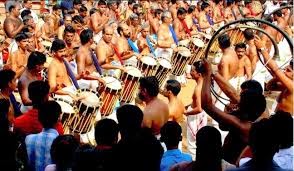

Chenda melam at Thrissur Pooram

The Chenda is a round and hollow wooden drum, and has a length of two feet and a distance across of one foot. Both finishes are secured (for the most part with creature's skin) with the "Chenda Vattam". The creature skin is generally of a cow (Heifer), in a customary Chenda different skins are not utilized (skin of bull, bull and so on are not utilized), to have a quality sound the skin from the stomach piece of the dairy animals is taken. The Chenda is suspended from the drummers neck with the goal that it hangs vertically. In spite of the fact that both sides can be utilized for playing, stand out is really beaten. Utilizing two sticks, the drummer strikes the upper material. This instrument is renowned for its noisy and inflexible sound. 

Kombu a C-formed trumpet made of metal or copper is a wind instrument utilized as a part of the condition of Kerala in South India. "Kombu" actually means horn in Malayalam and the instrument is formed like a since quite a while ago bended horn. 

The popular Thrissur Pooram celebration is a standout amongst the most bright and staggering open celebrations of Kerala, which has awesome open interest. 

It is held at the Vadakkunnathan Temple in Thrissur town consistently on the "Pooram" , day of the Malayalam Calendar month of 'Medam'. "Pooram" day is the day when the moon ascends with the Pooram star.

Kuda Mattam at Thrissur Pooram

Kudamattam or Kudamattom, the most bright piece of this terrific celebration is one of the occasions behind the staggering accomplishment of the celebration. Held at night, the occasion has the menfolk of Paramekkavu and Thiruvambady quickly changing their sequined umbrellas in a steady progression in a focused state of mind. The different percussion groups and extraordinary ceremonies, all add appeal to this pageantry.
Fireworks at Thrissur Pooram

The primary round of fireworks, known as Sample Vedikettu, happens on the fourth day after the banner raising of the Pooram. It is an one hour show exhibited by Thiruvambady and Paramekkavu Devawsoms. Swaraj Round is venue for this firecrackers and begins at 7:15 PM at night. The showcase typically have creative examples and mixtures of firecrackers presentation.

Firecrackers are a vital piece of all occasions in Kerala .But in Thrissur Pooram, the fire works are unmistakable in character, execution, magnificence and greatness. Both Thiruvambady and Paramekkavu sanctuaries rival one another to give the group the best and the most startling. 

Individuals originate from faraway spots to watch this stunning presentation of fireworks. There are four noteworthy firecracker shows in Thrissur Pooram. The 'specimen firecrackers' on the day preceding the Pooram, the beautiful sparklers that light up the sky (amittu) by both sides on the Pooram evening after the Southward Descent, the most noteworthy occasion that stamp the crest of Pooram festivals in the early morning hours, and the last firecrackers the accompanying twelve after the Goddesses offer goodbye to one another that check the end of Pooram.


Kerala at a Glance


Kerala.
 
Wedged between the Western Ghats on the East and the Arabian Sea on the West, the narrow strip of land known as Kerala is a destination of a lifetime.
 
Kerala at a Glance
 
With the Arabian Sea in the west, the Western Ghats towering 500-2700 m in the east and networked by 44 rivers, Kerala enjoys unique geographical features that have made it one of the most sought after tourist destinations in Asia. An equable climate. A long shoreline with serene beaches. Tranquil stretches of emerald backwaters. Lush hill stations and exotic wildlife. Waterfalls. Sprawling plantations and paddy fields. Ayurvedic health holidays. Enchanting art forms. Magical festivals. Historic and cultural monuments. An exotic cuisine... All of which offer you a unique experience. And what's more, each of these charming destinations is only a two hour drive from the other - a singular advantage no other destination offers. Kerala, India's most advanced society: With hundred percent literacy. World-class health care systems. India's lowest infant mortality and highest life expectancy rates. The highest physical quality of life in India. Peaceful and pristine, Kerala is India's cleanest state.
 
People and Life
 
Kerala is one of India's most progressive states in terms of social welfare and quality of life. The State boasts of one of India's highest literacy rates, highest life expectancy and lowest child mortality rates. The literacy rate for women is one of the highest in all of Asia. Enjoying a unique cosmopolitan viewpoint, the people of Kerala, at all levels of society, have greater access to services and opportunities - as well as a greater say in their governance.
 
Why is kerala called Gods own country ?
 
According to Hindu mythology, Kerala was created by Lord Parasurama, an incarnation of Lord Vishnu by throwing his axe across the sea to create new land for his devotees to live peacefully. So, Kereala is God's own creation, hence it is called God's own country!

Every nook and corner in Kerala you will see Hindu temples, Muslim mosques and Christian Churches; and unlike many other parts of India, people live happily without communal riots and great religiuos tolerance. Hence it is God's own country full of worship places!

Nestled between the pristine waters of the Arabian sea on the west and the lush Western Ghat mountains on the east, its intense network of rivers and lagoons, thick forests, exotic wildlife, tranquil stretches of emerald backwaters and a long shoreline of serene beaches make it a traveler's paradise. God's own country! Paradire.

 
Kerala, the Land of Ayurveda
 
Kerala possesses an unbroken tradition of Ayurveda that has surpassed the many invasions and intrusions both foreign and native. For hundreds of years the Ayurveda Vaidyas (traditional practitioners of Ayurveda) were almost the only access for people seeking healing from every kind of disease in Kerala. The legendary eight families of Vaidyas (Ashta vaidyas) and their successors treated the entire state for centuries. Unlike the other Indian states the status of Ayurveda in Kerala is not alternative but mainstream. In fact, today, Kerala is the only State in India which practices this system of medicine with absolute dedication.
Being the only resort of treatment for the people, the Vaidyars of Kerala were challenged to interpret the theories of Ayurveda and adapt them actively into effective healing systems in everyday life. Thus almost all the contemporary procedures and protocols of Ayurveda have evolved in and around Kerala.

 
The Boons of Nature
 
Its equable climate, natural abundance of forests and the cool monsoon season are best suited for Ayurveda's curative and restorative packages. Kerala is perhaps one of the few places on earth where a temperature of 24-28 degrees is maintained during a period of continuous rain. This prevalence of moisture in the air and on the surface of the skin makes it the ideal place for natural medicines to work at their highest levels of potency. The land is also blessed with innumerous medicinal plants and provides the continuity and consistency of Ayurveda medicines needed for effective treatment procedures. The same herbs with the same potency are available year after year across every season. The rich alkaloid content of the soil enhances the intensity and potency of many Ayurvedic medicines when compared to places with different soil constitution.
 
The Advantages of Ayurveda in Kerala
 
Ashtangahridayam, the practical, user friendly interpretation of Ayurveda, compiled by the great Vagbata is seldom used anywhere in the world as it is extensively done in Kerala. The Vaidyars of Kerala are proficient in this most contemporary treatise of Ayurveda which many scholars consider an advancement over the earlier samhitas of Charaka and Sushruta, the pioneers of Ayurveda. It is in Kerala that Kashaya Chikitsa (treatment with concoction) has become a standardised protocol involving hundreds of Kashayams that were scientifically classified and organised according to various treatment needs. Keralite Vaidyars where the first to focus on the anti oxidant properties of Abayangam leading to the profusion of kizhis. The largest number of Ayurveda colleges and the largest number of practitioners in comparison to any place in the world has led to a tradition of Ayurveda research in a scientific manner in Kerala.

Ayurveda as a lifestyle


Ayurveda is not just about good physical health. It is a therapy that promises holistic wellness. The natural herbs and oils used in the therapy are of great medicinal value as is said in the Vedic literature on Ayurveda. The history of Ayurveda which can be traced back to the Vedic Ages clearly lays out instructions to maintain health as well as fighting illnesses through therapies such as massages, herbal medicines, diet control and exercise.

Elimination of toxic elements from the body is the primary function of this curing remedy. The system gets purified when the poisonous elements are removed from the body. As a result, the chances of falling ill are largely zeroed down which makes one feel tension-free. It rejuvenates the mind, body and soul.

Charaka Samhitha (Treatise on Medicine), Susrutha Samhitha (Treatise on Surgery) and Ashtanga Samgraha (Treatise on the basic principles) are the three major treatises in Ayurveda. These treatises tell us that every individual has a unique constitution. Every organ or system has an energy related to it and there has to be equilibrium between them. The balance generally gets affected when we fall ill. The objective of Ayurveda is to reestablish this equilibrium in order to maintain good health.

Kerala has a number of Ayurveda treatment centres which offer various packages. From treatments like uzhichil and pizhichil to curing illnesses like arthritis to beauty massages for the skin and hair; there is no place better than Kerala to seek the benefits of Ayurveda. Kerala has a number of natural herbs such as Aswagandha, Amalki, Katphal, Brahmi, Bharangi, Yashtimadhu, Shankhupusham to name a few. Turmeric, Cinnamon, Keezharnelli (Phylantus Amarus), Kilukillapa (Crotalaria Retusa Linn), Koduveli (Plumbago Zeylanica Linn) and many more herbs with medicinal values are found in Kerala.

The rainy season, from June to September, is the ideal time for Ayurvedic treatments because the atmosphere remains cool, moist, and dust free. This opens up the body’s pores, making it receptive to herbal oils and therapy. The places offering the best packages in Ayurveda in Kerala are : Somatheeram Ayruveda Resort near Kovalam, Kottakkal Arya Vaidya Shala which is a hospital, Beach and Lake Ayurveda Resort and Surya Samudra Spa Niraamaya at Tivandrum, Keralyeem Ayurvedic resort near Allepey and Ayurkshethra at Kumarakom.
 
Yoga
A series of physical and mental disciplines, Yoga is a meditative practice believed to have been originated in India. Vedic Literature contains references to ascetics, as early as 900 to 500 BC. Some of the seals discovered from the Indus Valley Civilization sites have figures in postures resembling the ones in Yoga. According to the Katha Upanishad, Yoga refers to the control of the senses and mental equilibrium. The Upanishads, the Bhagavad-Gita, the Mahabharata and the Yoga Sutras of Patanjali are the most important textual sources about the concept of Yoga.

The goal of yoga is the attainment of a sound mind in a healthy body. It helps one become aware of the self, control one’s emotions and to think straight. Yoga is also believed to help one achieve Moksha-the liberation from all worldly sufferings and the phases of birth and death. Though the postures of Yoga are designed to give mental and spiritual well being, it also improves ones physical health.

The most noted propagator of Yoga was the great sage Patanjali who wrote the ‘Yoga Sutras’. He spoke about an eight fold path from suffering and pain through Yoga. Of these, the first five elements are known as External (Bahiranga) Yoga or Hath Yoga while the last three are referred to as Internal (Antaranga) Yoga or Raja Yoga.

Kerala has a number of Yoga and meditation centres where experts guide you through the entire process of learning Yoga. They train you after completely understanding your pace and learning ability. Your present medical condition, the difficulty you have with certain poses and what is most comfortable for you are studied by these professionals. Kerala, with its pollution-free environment and tranquil surroundings is the idyllic place to practice Yoga and seek peace of mind.


Sree Padmanabhaswamy Temple Thiruvanandapuram

 
Located inside the East Fort in Thiruvananthapuram, the capital city of the State of Kerala in India is the Sree Padmanabha Swamy temple dedicated to Lord Vishnu. This temple is a blend of the Kerala and Dravidian styles of architecture.
The history of Sree Padmanabhaswamy Temple dates back to 8th century. It is one of the 108 sacred Vishnu temples or Divya Desams in India. Divya Desams are the holiest abodes of the Lord Vishnu that are mentioned in the works of the Tamil Azhvars (saints). The presiding deity of this temple is Lord Vishnu, reclining on Anantha, the hooded Serpent.
Marthanda Varma, the noted among Travancore kings did a major renovation to the temple and it resulted in the present day structure of the Sree Padmanabhaswamy temple. It was Marthanda Varma who introduced the Murajapam and Bhadra Deepam festivals in the temple. Murajapam, which literally means continuous chanting of prayers, is still conducted in the temple once in six years.
 
In 1750, Marthanda Varma dedicated the kingdom of Travancore to Lord Padmanabha. Marthanda Varma vowed that the royal family will rule the state on behalf of Lord and he and his descendants would serve the kingdom as Padmanabha Dasa or the Servant of Lord Padmanabha. Since then the name of every Travancore King was preceded by the title Padmanabha Dasa. The donation of the kingdom of Travancore to Padmanabhaswamy was known as Thripadidanam. The current head of the Travancore Royal Family is Uthradom Thirunal Marthanda Varma.
Thiruvananthapuram, the capital city of Kerala takes its name from the presiding deity of the Sree Padmanabha Swamy temple, who is also known as Anantha (one who reclines on the Serpent Ananatha). The word 'Thiruvananthapuram' literally means - the land of Sree Anantha Padmanabhaswamy. 
The Sree Padmanabhaswamy temple as per belief is located at a place that is considered as one of the seven Parasurama Kshetras. And references of this temple are there in texts like the Puranas, viz. the Skanda Purana and Padma Purana. The temple stands close to the holy tank - Padma Theertham, which means 'lotus spring.'
The shrine is currently run by a trust headed by the erstwhile royal family of Travancore.
The Idol
 
The idol of the presiding deity of the Sree Padmanabhaswamy Temple is noted for its composition, which has 12008 salagramams, which were brought from Nepal, taken from the banks of the River Gandhaki.
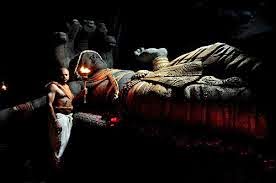
The garbhagriha or the sanctum sanctorum of Sree Padmanabhaswamy temple is located on a stone slab and the main idol, which is about 18 ft long, can be viewed through three different doors. The head and chest are seen through the first door; while the hands can be sighted through the second door and the feet through the third door.
 
Aesthetics and architecture
 
The temple architecture stands out for its work in stone and bronze. The temple interiors are adorned by beautiful paintings and murals. Some of them are that of the life-size images of Lord Vishnu in the reclining posture, Narasimha Swamy (half-lion, half man incarnation of Lord Vishnu), Lord Ganapati and Gaja Lakshmi. The temple has a dhwaja stamba (flag post) that is about 80 ft high and is covered with gold plated copper sheets.
The temple also has some interesting structural features in the form of Bali Peeda Mandapamand Mukha Mandapam. These are halls, decorated with beautiful sculptures of various Hindu deities. Another structure that captures attention here is the Navagraha Mandapa the ceiling of which displays the navagrahas (the nine planets).
 
Broad corridor with 365 and 1/4 sculptured granite stone pillars

Extending from the eastern side into the sanctum sanctorum is a broad corridor which has 365 and one-quarter sculptured granite-stone pillars with beautiful carvings. There is a ground floor below under the main entrance in the eastern side, which is known as the nataka sala, where Kerala's classical art form - the Kathakali is performed during the annual ten-day festival at the temple, held during the Malayalam months of Meenam and Thulam.
 
Worship time at the Sree Padmanabhaswamy temple

Morning hours:

03:30 a.m. to 04:45 a.m. (Nirmalya Darshanam)
06:30 a.m. to 07:00 a.m.
8.30 a.m. to 10:00 a.m.
10:30 a.m. to 11:10 a.m.
11:45 a.m. to 12:00 Noon
 
Evening hours:

05:00 p.m. to 06:15 p.m.
06:45 p.m. to 07:20 p.m.

Please note that the temple worship timings are subject to change during festival occasion.
 
Dress code to be followed at the temple:

Only Hindus are permitted inside the temple.
There is a strict dress code that needs to be followed while entering the temple. Men need to wear mundu or dhoti (worn around the waist and going down up to the heels) and should not wear shirts of any kind.
Women need to wear sarimundum neriyathum (set-mundu), skirt and blouse, or half sari.
Dhotis are available for rent at the temple entrance. Nowadays temple authorities allow wearing of dhotis over pants or churidhar to avoid inconvenience to the devotees.